 UAE
 KSA
Industry Solutions
How to Manage Manpower Timesheets Without Errors or Manual Data Entry
November 23, 2026
Introducing QuickDice ERP - The Premier Accounting Solution for UAE Businesses with Exceptional Results!
Why Do Branch-Wise Sales Reports Differ from Consolidated VAT Reports?
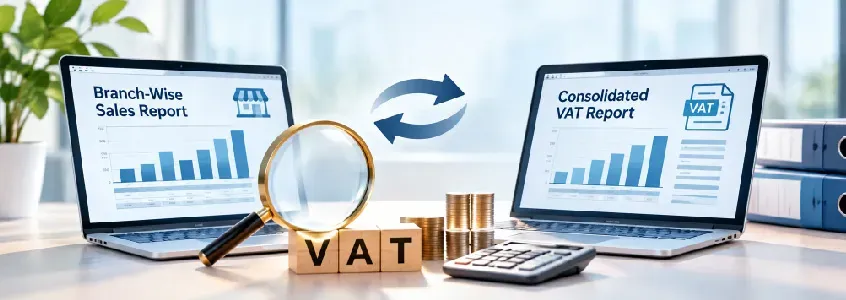
Table of Contents
Businesses operating multiple branches maintain separate sales records to monitor revenue, customer transactions, discounts, and returns at each location. But a combination of these records to report VAT may yield some shocking variances. The knowledge of Branch-Wise Sales Reports assists companies to detect any discrepancies and keep the right financial data of their business activities.
Using UAE Tax Compliant Accounting Software helps businesses organize transactions, improve VAT calculations, and maintain consistent financial records. When used correctly in reporting, Quickdice erp allows improved financial visibility, eases the reconciliation process and allows a company to realize the need to ensure proper reporting of VAT among the various branches.
Branch-wise sales reports are the reports that give an in-depth analysis of the sales that are made by particular business locations in a given period of time. They assist the management to track the sales performance, customer transactions, returns, discounts and credit notes individually. These reports assist in location based comparisons, profitable branches, operational problems, and allow the businesses to make informed decisions by giving them more insight into the financial operations of each branch.
The consolidated VAT reports involve combining VAT-related transactions of various branches into a single financial overview to be reported. They consist of output VAT that is imposed on taxable sales and input VAT on purchases that are eligible. These reports categorize the transactions as standard-rated, zero-rated and exempt supplies, which assist companies to calculate their VAT liabilities and prepare proper UAE VAT returns.
Various branches might come up with reports with varying transactions dates or periods. Wrong cut-off dates may be used to omit some invoices, or to include some transactions in one period which would be counted in another period causing inconsistencies in consolidated figures and individual branch sales.
Wrong VAT code will result in differing transactions in financial and tax reports. Branch-Wise Sales Reports can have sales in different categories and consolidated VAT reports will have the same sales in different locations under tax codes that have been configured leading to discrepancies.
The initial taxable sales value can be altered by the sales returns and credit notes once an invoice has been issued. By recording such adjustments at varying times the sales reports by the branches might not necessarily reflect the figures recorded in the consolidated VAT reporting.
Companies regularly move stocks among their divisions in order to regulate the stock levels and market needs. These internal movements ought to be separated with actual taxable supplies. The wrong recording of stock transfer as sales may inflate the reported revenue and lead to unnecessary differences when reconciling VAT.
Handwritten accounting procedures enhance the chances of multiple entries of invoices, lost entries and wrong VAT values. Branch-Wise Sales Reports could also be inaccurate where employees will key in the transactions in a varied manner and thus it is hard to reconcile the individual sales records to overall financial and tax statements.
Discounts affect the taxable value of sales, and should be properly kept in the accounting systems. The variations in the application of promotional offers, invoice discounts and after sales adjustments by the branches may cause differences between the reported revenues and the taxable revenues in the VAT calculations.
Report configurations may affect the transactions to be included in financial summaries. Branch-Wise Sales Reports can be posted invoices only, whereas the consolidated reports have alternative filters or accounting settings. The differences in cash and accrual reporting may also impact on the comparison of the branch level and consolidated figures.
Test individual branch reporting and consolidated VAT reporting have the same reporting periods. Check invoice dates, transaction posting dates and reporting cut-off settings to make sure that all the sales transactions are reflected in the two reports.
Test invoices that have been made by each branch and compare the values of transactions with consolidated accounting entries. Check invoice numbers, customer information, taxable amount, and posting statuses to determine missing, duplicated or wrongly recorded sales transactions.
Check VAT codes of all sales transactions at all the branches. Ensure that standard-rated, zero-rated and exempt supplies are set up appropriately and that the relevant rates of VAT are always set up in the accounting system.
Check the sales returns, refunds and credit notes that have been made in the course of the reporting period. Correlate each adjustment with its respective invoice and ensure that the same has been appropriately updated in the records of the financial statements in terms of values and VAT.
Recognize stock moves and other moves that take place among business locations. Make sure internal inventory flows are separated and determined as such and verify mis-coded transactions that might impact consolidated sales and VAT numbers.
Compare taxable sales amounts and amounts of VAT between branch level and consolidated reports. Explore variations in taxable values and tax computations, discounts and adjustments to discover whether the variation is due to recording errors or reporting set ups.
Keep record of reconciliation with differences identified, their cause and corrective measures. Supporting invoices and credit notes and adjustment entries assist finance teams to clarify discrepancies and keep good records that will be reviewed later to assess VAT.
Gathering financial data may be complex as the accounting procedures in different branches may be different. Regular reporting processes are required to enable businesses to categorize transactions, keep track of revenue and keep proper records without missing out on crucial financial data.
Various employees might use various procedures in the process of recording taxable transactions. Homogeneous VAT codes, invoice forms, accounting policies aid in ensuring that businesses have dependable information on taxes and minimize errors in classification in all the locations of operations.
Integration of financial transactions of multiple branches would demand proper data synchronization and uniform reporting parameters. Lost records, invoices with two entries, and unlinked systems can have an impact on consolidated numbers and complicate VAT preparation among finance teams.
Adjustments in sales are often made once the original invoices have been made. Businesses are to keep keen eye on the refunds, returns, credit notes to make sure the change is recorded in the branch level records and consolidated VAT reports.
When preparing VAT returns businesses need to examine taxable supplies, input VAT refundable and modifications and financial records. Branch information inconsistency will add more work to reconciliation, and may cause problems in determining the appropriate VAT liability.
To assist in accounting, businesses require readily available invoices, receipts, credit notes and transaction records. Formatted documentation enhances traceability, ease in finance audit, and assists an enterprise in responding effectively in instances where more VAT data is needed.
A centralized accounting platform links financial data across business locations in a single platform. Branch level transactions, revenue tracking, and consolidated records are available to finance teams, without the gathering of individual spreadsheets. This enhances consistency in information and eases reporting processes.
Automated VAT calculation eliminates the need to focus on manual calculation of taxes and repetitive data input. Correctly set tax regulations can assist companies with the calculation of relevant VAT, when invoicing and recording transactions. This enhances uniformity and minimizes unnecessary computation errors.
The real-time reporting provides the management with a better insight of the financial operations in various locations. Information can be made available and teams can track the sales revenue, customer transactions, discounts and returns. This facilitates quicker comparisons of performance as well as enhancing financial tracking.
Consolidated reporting consolidates VAT-related information of various branches into a single structured overview. Businesses are able to audit taxable supplies, output VAT, qualified input VAT and adjustments in a better manner. Centralized information will make it easier to reconcile information and help to prepare VAT returns correctly.
Trustworthy accounting records assist businesses to track the transactions since they were initially recorded to later modifications. Audit trails keep records of invoices, changes and the financial transactions. This enhances accountability, facilitates in-house audits and makes document access easier.
QuickDice ERP assists companies to coordinate sales data of various operating locations in a networked accounting set up. The finance departments are able to track branch level transaction, examine revenue and centralized financial data and this will facilitate unified sales tracking across various branches.
Systemized records of transactions and established VAT policies facilitate easy computation and reconciliation of tax. Businesses will be able to analyze taxable operations, compare the amount of VAT, and detect discrepancies more effectively, eliminating manual repetitive labor and promoting well-organized financial reporting.
QuickDice ERP also helps in preparing financial reports by grouping transaction data into readily available reports. Businesses are able to check on the sales performance, taxable supplies and VAT-related figures and be in better control of accounting information and assist in preparation of VAT returns.
Centralized financial information gives the management a better idea on the transactions of the business in various branches. The teams will be able to analyze sales operations, track changes, and examine suspicious numbers to support making informed financial choices and structured accounting.
Knowledge on differences of Branch-Wise Sales Reports and consolidated VAT report is vital to business that have various locations within the UAE. Accounting errors, credit notes, reporting periods, VAT classes, inter-branch transactions and reporting periods can manipulate financial figures. Regular reconciliation assists in determining these problems, enhance uniformity in reporting and ensure that there is correctness in VAT records throughout the business locations.
Implementing appropriate accounting practices and centralized reporting systems makes financial management easier. As businesses grow, VAT reporting can be reinforced with the right transaction records, automated calculations, and with reliable reconciliation procedures, businesses can enhance their financial visibility and have stronger control.
Differences occur due to the periods of reporting, VAT categories, invoice missing, credit notes, discounts and accounting mistakes.
Not necessarily because VAT changes, classification of transactions and differences in reporting may impact on consolidated totals.
Compare reporting periods, check invoices, check VAT codes, check adjustments and look into discrepancies.
True internal stock transfer is usually not a taxable supply as per the existing UAE VAT regulations.
It automates VAT, centralizes transactions, standardizes tax classifications and enhances accuracy of reporting.
It is supposed to provide automated VAT calculation, multi-branch accounting, consolidated reports, reconciliation options and audit trails.