
 UAE
UAE
 KSA
KSA
Product Updates
Why UAE Businesses Should Automate End-of-Service Benefit Calculations
September 19, 2026
Introducing QuickDice ERP - The Premier Accounting Solution for UAE Businesses with Exceptional Results!
How Do Companies Track Employee Check-In and Check-Out in Camps
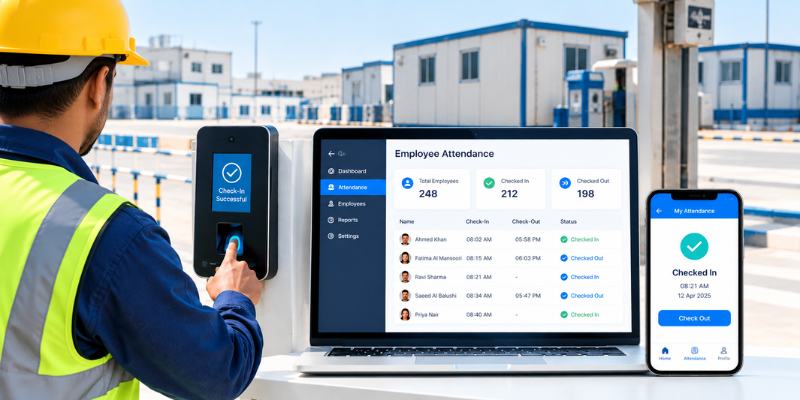
Table of Contents
Managing attendance in remote camps can be challenging when employees work across different shifts, locations, and schedules. Businesses require effective methods of determining the time of arrival and departure of workers, inter-location and availability of the workers at working hours. Employee check-in and check-out in camps facilitate better accuracy in attendance, workforce visibility, safety and payroll management with less manual effort.
Contemporary solution integrates mobile devices, biometrics, RFID, GPS, geofencing, and a centralized record. Quickdice ae can assist businesses to handle the attendance information more effectively in a challenging camp setting and Camp Registration Software UAE can facilitate the running of organized camps.
· Multiple employee shifts
· Remote camp locations
· Limited internet connectivity
· Manual attendance errors
· Proxy check-ins
· Delayed attendance updates
· Difficult workforce visibility
Proper attendance records assist companies to verify working hours, organize shifts, payroll, dispute cases, as well as accountability. Consistent workforce information as a result of reliable employee check-in and check-out in camps records also gives managers reliable information in their operational decisions.
With attendance tracking, supervisors have a better insight into the availability of employees, shift coverage, absences and overtime. Digital employee check-in and check-out in camps systems minimize administrative effort, enhance scheduling decisions, and assist managers to react swiftly to attendance patterns that result in workforce gaps.
Check in and check out details assist the managers to know who is within a camp or a worksite at a particular time. In case of an emergency, the precise attendance records facilitate quicker roll calls, employee checks, coordinating evacuations, and responsibility in the areas of the remote operations.
Manual registers are still used in the case of small operations or where technology access is restricted. Arrival and departure times are registered on paper by employees and paper is reviewed by the supervisors. Nonetheless, this method may result in errors in calculations, records, and reporting delays and reduced visibility.
RFID cards enable employees to register attendance by tapping or scanning identification cards at specific access points. The system automatically captures timestamps, minimizes manual entry, and offers a viable solution to monitored camp entrances and employee movement.
Biometric systems confirm the identity of employees by fingerprints, face recognition or any other acceptable identifiers. This will enhance identity check and proxy attendance. Employers are able to link biometric data to attendance systems to ensure consistency of information about the working hours and automatic reporting.
Mobile attendance apps enable the employees to check attendance using smartphones or tablets. Check-ins can record time, identity, location, and device data based on system design, providing supervisors with easy access to the dispersed camps and places of temporary workforce.
Attendance systems using GPS to check the location of employees are used when taking attendance. Geofencing would allow companies to limit check-in to geofenced areas, and ensure that employees are physically present within authorized camp or worksite limits before they can be counted.
Combined systems relate employee data, attendance, accommodation data, shifts and operational data. This provides a centralized workforce perspective, and may simplify the employee check-in and check-out in camps as well as monitoring, reporting and managing employees in multiple locations.
An employee verifies him or herself using a mobile application, biometric device, RFID card or any other acceptable means. The system saves the time of check-in and can record location or identity details and update attendance registers to supervisors.
At the end of a shift, the employees with the help of the same approved method complete the check-out process. The system logs out time, and works where programmed and updates in attendance data to payroll or management.
GPS and geofencing services involves comparing the location reported by an employee with the authorized areas of attendance. When the device is not within the boundary, then the system can either inhibit the submission of attendance or alert the supervisor to review the record.
Digital systems are able to update attendance records upon successful check-ins or check-outs. Supervisors can have a faster insight of the employees in terms of their presence, absence, late coming and leaving, which helps them make swift operational decisions as well as better coordination of the workforce.
Attendance systems are able to produce reports based on the check-in, check-out, shift, overtime, absence and location reports. Automated reports save on spreadsheet work, assist managers to review attendance patterns and payroll inputs, and workforce performance more regularly.
Real-time monitoring will provide supervisors with real-time attendance. Managers will be able to detect absenteeism, tardiness, early check-out and check-in employees, and staffing shortages almost instantly, enhancing day-to-day coordination of the camp and labor control at various shifts and locations.
Attendance records are connected to the location of the employee during the approved activities with GPS tracking. This is an added confirmation of dispersed operations and assists supervisors to ensure that they are present in locations they are supposed to be in case of a scheduled shift of a camp or worksite.
Geofencing puts virtual fences around authorized areas of attendances. Employees are only able to check in within specified locations, which minimizes inaccurate location reporting, and enhances confidence in the events of attendance recorded in remote camp operations.
Identity verification and biometric ensures that the registered employee attends to each attendance event. These controls minimize proxy check-ins, enhance accountability and provide reliable workforce administration and payroll preparation records.
Automated notifications inform supervisors of check-in and late arrivals, early departures, odd attendance incidents and preset exceptions. Prompt alerts enable managers to act on the attendance problems before it impacts the staffing, payroll or day-to-day operations.
Offline attendance feature allows the employees to mark their attendance when they are offline. Information stored is synchronized upon connections being re-established, and allows remote camps to have constant attendance records even with limited internet or mobile networks.
Automated attendance records time and identify of employees in a similar manner, eliminating errors related to handwriting, duplicity and errors of calculations. Proper records assist organizations in maintaining working hours, absences, overtime and payroll information with good confidence.
Unauthorized entries of attendance are harder due to identity checks, location restrictions, and time-stamps. The companies can establish who checked in, the time of the event and whether the place was within the approved areas of operation.
Centralized attendance data gives managers a better understanding of the availability of workforce per camp, per shift and per work site. The visibility aids in the allocation of employees, quicker response to employee shortages, and enhanced coordination of supervisors and operations teams.
Automated attendance saves on the time it would take to gather, confirm as well as compute working hours. Payroll integrations are capable of facilitating quicker timesheet creation, computation of overtime, payroll examination, and routine administrative handling.
A list of which employees are at work is also useful in case of an incident, evacuation and emergency roll calls. The quality attendance records assist the supervisors to locate missing staffs, organize responses, and enhance accountability throughout the high risk camp settings.
Paper registers and spreadsheets are some of the repetitive work that is minimized by digital attendance. The supervisors require less time to gather entries, rectify the accounts, make reports and search historic records and they are able to be more concerned with the running of the camp.
Working in remote camps usually necessitates scattered workforce, transportation difficulties, and inadequate infrastructure. Digital attendance systems aid the supervisor with a trusted workforce record that assists in visibility of the employee presence, planned shifts, and daily work demands.
Workers can move between accommodation camps and different work sites during shifts. Attendance systems may capture authorized movement or work on site attendance, which assists managers to comprehend the workforce allocation and have a clearer record across sites.
Attendance systems assist managers to determine whether the employees were at work as scheduled and finishing anticipated shifts. Check-in, location checks, and supervisor checks are more powerful workforce visibility tools that do not need to solely be based on manual observation.
In case of an emergency, the managers require accurate information on personnel. Digital attendance records can be used to back roll calls and muster operations by displaying registered employees, recent attendance records and possibly known camp or worksite locations.
There can be unreliable or no internet in remote camps. Attendance events can be stored locally in a system offline, and synchronized when there is a connection again, to maintain continuity in operations and minimize missing or delayed attendance records.
Manual tracking involves the use of paper registers, or spreadsheet or logs kept by supervisors. It is suitable with smaller camps with simple scheduling, but becomes more difficult to be accurate as the number of employees, shifts, locations and reporting needs grow.
Digital tracking involves application, biometrics, RFID, GPS or integrated platforms to record the attendance electronically. It offers quicker updates, centralized databases, automated reporting and enhanced verification of intricate workforce settings.
The manual systems demand increased administration and present more chances of mistakes. Digital systems can be costly but enhance precision, quicker reporting, validating, scaling and operational effectiveness in the long term.
Online attendance tends to be more feasible with large camps due to its ability to cater to numerous employees, shifts, locations, and reporting needs. Workforce management is made easy when automated verification and centralized records are involved as operations are increased.
Organizations ought to develop clear-cut policies clarifying on when, where and how staffs are to record attendance. Regular rules lower the confusion level, enhance the compliance level and assist supervisors to handle missed, late, or wrong events of attendance between shifts.
Location verification may enhance the accuracy of attendance when workers labor within specific areas of a camp or worksite. GPS and geofencing can be implemented in a considered manner taking in consideration the operational requirements, privacy, devices limitations, and demands.
Profiles of the employees, schedules and departments, roles and shift assignments should be kept up to date. Correct records assist the attendance systems to correctly match employees, minimize administrative corrections and give an accurate workforce planning information.
The automated alerts will be able to detect employees who fail to attend the anticipated events. Supervisors are able to explore exceptions swiftly, verify real absences, tackle technical difficulties, and avoid the incompleteness of records to impact payroll or scheduling.
Access controls, authentication, encryption, permissions, and appropriate retention practices should be employed in the attendance systems. Firms must limit sensitive data on attendance and location to users only and have transparent data security measures.
Frequent attendance checks also assist managers to see the trends of lateness, absenteeism, overtime, missing records and irregular activity. The schedule of reports can be compared with the schedules to identify weaknesses in the process and facilitate the ongoing workforce management improvement.
Select a system that meets employee requirements (numbers, shifts, locations and attendance). The solution can be used to scale to support workforce increase and the new camps without businesses having to upgrade their technology.
Determine the presence of Wi-Fi, mobile networks and interruptions to connectivity within the camps. Offline attendance systems and auto syncing systems have the capability to keep good records when the remote sites have unstable or no internet connection.
Connection to HR, payroll, time sheets, access control and camp management systems minimize redundant keying in of data. Firms ought to check compatibility to guarantee the flow of attendance information among the key operating and administrative systems is smooth.
Make comparisons of authentication, biometric, GPS, geofencing, permissions, audit trail and data protection controls. The chosen combination ought to offer reliable attendance checking yet be feasible to both employees and supervisors.
The features of reporting must be able to facilitate attendances, absences, overtime, late arrivals, shift performance and exceptions. Easy to understand dashboards and customizable reports enable managers to turn attendance information into valuable workforce management information.
Assess installation costs, equipment, software charges, service, support, connection and expansion. It should provide a scalable system to support more employees, camps and locations without introducing a lot of administrative complexity and long-term costs.
Effective employee check-in and check-out in camps helps companies monitor attendance, working hours, and employee presence accurately. Digital systems minimize manual mistakes, enhance verification, help with payroll processing and enhance accountability in emergency situations throughout remote camp operations.
Workforce management can be enhanced by selecting appropriate technology, keeping procedures straight and frequent review of attendance records. When choosing systems that will allow companies to operate effective and reliable camp attendance, companies should take into account the concept of connectivity, security, scalability, and integration.
The digital attendance system, geofencing, GPS, RFID, biometrics, or mobile apps are applied by companies.
An online system that is GPS-enabled, offline, verifiable and automated to provide reports would be appropriate.
Yes systems which are offline-enabled, can take attendance and match it in the future.
Sure there are numerous systems that can link attendance data to payroll and HR systems.
Yes employee identity verification can be secure and reliable with the help of biometrics.
It assists the managers to know the presence of the employees in cases of emergencies and evacuations as well as during roll calls.