 UAE
UAE
 KSA
KSA
VAT & E-Invoicing
How Can Small Businesses Manage VAT Accounting More Efficiently in the UAE
October 10, 2026
Introducing QuickDice ERP - The Premier Accounting Solution for UAE Businesses with Exceptional Results!
How Can Digital Invoicing Help UAE SMEs Manage Invoice Records
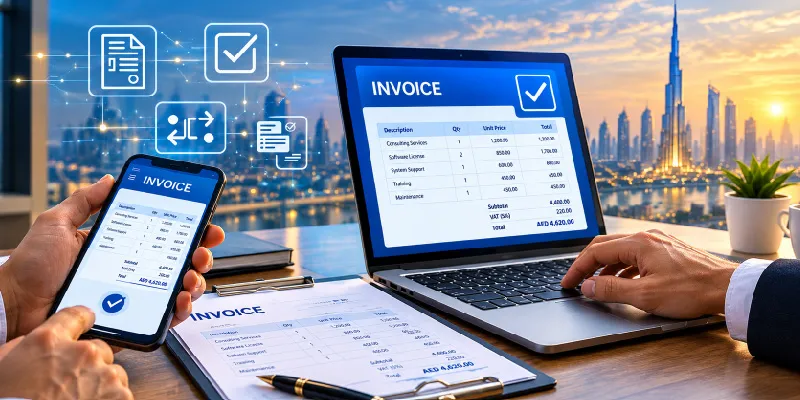
Table of Contents
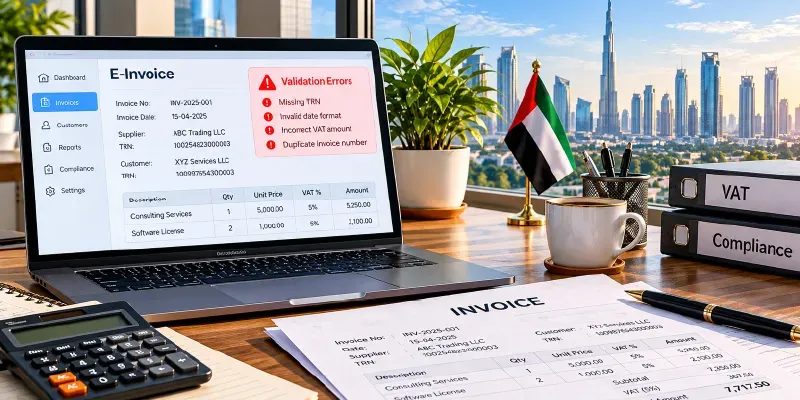
Managing invoice records can be challenging for UAE SMEs when documents are spread across emails, spreadsheets, folders, and paper files. Digital Invoicing assists business in creating, keeping, sorting and accessing invoice data more effectively. Using appropriate E-Invoicing Software for SMEs UAE businesses will be able to minimize redundant administrative processes, enhance accuracy and record transparency.
Properly kept records of invoices facilitate easier accounting, quicker collection and easier preparation of financial statements. Quickdice ae can assist businesses to consider viable invoicing options to suit their business operations. Digitization of the paper-based processes to systematized digital processes, also minimizes the lost paper documents and facilitates the accessibility of the essential transaction data when in need.
Digital invoicing creates, sends, receives, processes, and stores invoice information electronically. Structured systems allow businesses to create invoices, capture transaction details, impose appropriate tax information and store data electronically, eliminating manual paperwork and enhancing general access to records.
Paper invoices need to be stored physically, manually filed and even more efforts when documents have to be accessed. Online invoices may be saved in digital format; they can be easily searched, shared and are more connected to accounting processes to enhance efficiency.
Digital Invoicing is becoming more useful to SMEs, as it facilitates quicker processing, improved documentation and more accurate financial records. Electronic processes have the potential to decrease administrative lag times and assist business to cope with increasing transaction volumes without depending on heavy paper work.
Precise invoice records assist SMEs to verify, reconcile the accounts, track payments, and prepare financial reports. Availability of records enables authorized employees to access information fast minimizing delays and facilitating improved financial decision-making in different departments.
Digital Invoicing enables companies to store invoice data in an electronic hub. Employees can also access ordered records in a single system, instead of using a separate file and hence enhance consistency and also lessen chances of misplaced records.
Details that can be used to search electronic records include invoice numbers, customer name, date or transaction details. This ensures that retrieval is speedier than checking of physical folders manually and enables the employees to revert quicker to internal requests.
This can minimize typing and copying of documents that are repetitive because of automation of the invoice processes. By capturing information electronically and applying predefined processes, SMEs can lower the risk of common data-entry mistakes and maintain more reliable records.
Digital systems have the ability to monitor invoice progressions like formulation, dispatch, authorization and payment. Automated status updates will give a better insight into pending transactions, employees will be able to follow up on unpaid invoices and keep the records current.
Electronic invoice systems are able to sort records based on customer, supplier, date, category or type of a transaction. Regular organization simplifies the management of documents, their reviews, archiving and accessibility of financial information when needed.
Electronic records are capable of giving a more detailed account of the invoice operations such as its development, modification, approval and processing. This visibility assists businesses to learn how records were altered and enhances more customized internal audits and financial audits.
Digital Invoicing will promote standard processes of invoice writing and record-keeping throughout the organization. Regular formats, fields, numbering systems and storage systems can assist the SMEs to have reliable records as the volume of transactions keeps on increasing with time.
The workflow of digital invoices has the capacity to standardise vital data and minimise the amount of duplication of data. Regular data assists SMEs to reduce any differences between invoices, accounting, customer and payment records to aid more reliable financial management.
The searchable nature of electronic invoices allows employees to access the invoices rather than having to go through the physical files. The expedited access assists teams to respond to queries, confirm transactions, compile reports and reconcile without the needless administrative delays.
Examples of activities that can be automated through automated invoice processes include data capture, routing, status tracking and record storage. This will enable employees to waste less time carrying out paperwork and devoting more time to business operations and serving the customers.
Electronic records minimize the use of printed invoices, filing cabinets, physical folders and storage of documents. SMEs have the potential to reduce the daily paperwork costs, as well as maintain valuable information in regulated digital storage.
Detailed records of invoices assist companies to track issued, pending, overdue and paid invoices. By being more visible, the finance teams will better be able to detect outstanding amounts early, contact customers and have a more predictable payment management.
Information about the invoices is sent to the authorised personnel without the need to wait the physical documents to transfer across departments. Digital records shared enhance coordination of all finance, sales, purchasing and management teams and minimize time wastage in communication.
Systematic invoice records provide SMEs with a better understanding of the activity and outstanding balance. The reliability of information can be used to support the financial reporting, reconciliation, budgeting, cash-flow analysis and management decision making based on the existing record.
Businesses should maintain complete invoice information that accurately reflects transactions. Digital records systems may also facilitate uniform capture and storage of pertinent information, which makes it easier to enable SMEs to have structured records on accounting and compliance grounds.
Electronic invoice records have the potential to enable businesses to keep the information of transactions in relation to VAT accounting. Organized storage simplifies access to invoices to review, reconcile, and match them with other financial documents when needed to manage a business.
Properly structured digital documentation enables the relevant invoices to be found with ease in case of reviews or audits. The amount of time spent on document collection and facilitating a more systematic review process is minimized as SMEs is able to access information about transactions quickly.
Businesses can use digital workflows to become more comfortable with electronic invoice creation, processing, storage, and data management. An early preparation can enable SMEs to discover the gaps in processes in advance of the operation being impacted by relevant e-invoicing requirements in the UAE.
Digital Invoicing solutions are supposed to facilitate the use of relevant UAE tax, data, security and e-invoicing needs. SMEs need to consider the capabilities of the systems they use to maintain accurate records of invoices that are easy to access, secure and likely to meet future regulatory demands.
Invoices numbers and dates enable businesses to determine single transactions and keep records in a chronological order. The repetitive numbering also helps in the reconciliation, tracking, reporting and identification of missing or duplicate invoices in the normal financial audit.
Records would include pertinent supplier and customer information that would be required to determine the parties to the transaction. Regular reporting assists SMEs to reconcile invoices to accounting records, payment activity, contracts, purchase orders and other supporting documents.
Descriptions are clear regarding what was provided and assist businesses to verify accuracy of transactions. Detailed descriptions may assist in the accounting, customer communication, reconciliation, reporting and review processes in case questions are raised on certain invoice transactions.
All required information on taxes should be updated properly as per requirements. The preservation of VAT related information aids companies in reconciling transactions, establish financial records, and aid in proper records when the records need to be reviewed.
Payment information assists the businesses in checking the status of invoices, whether they are not paid, paid partially or paid in full. Maintaining records of the transactions will help in tracking the cash-flow, reconciliation, follow-ups on payments and proper reporting of financials throughout the business.
Supportive documents can be purchase orders, delivery records, contracts, receipts or correspondence. Associating applicable attachments and invoice data forms better documentation and assists employees to confirm transactions without having to search at various places.
The invoices can be identified and tracked more easily, since a constant numbering system is used. To minimize duplication, ease reconciliation and enhance reliability of financial records, SMEs are encouraged to set some rules of numbering and use them throughout, as much as possible.
Logical categories assist employees to find records fast and keep records in a well-organized manner of financial information. SMEs are able to categorize invoices based on the customer, supplier, type of transaction, date or any other convenient parameters of their operations.
The automated retention and backup systems are used to ensure the important invoice information is not lost due to accidental deletion or failure of the device, or other inconveniences. Frequent backups are also a source of added assurance that historical records can be accessed when required.
Access controls are used to make sure that sensitive invoice information is only viewed, edited, approved or handled by authorized employees. Role-based permissions are able to minimize unwarranted modifications and can facilitate accountability between the finance and administrative personnel.
Regular checkups are useful in detecting the absent invoices, duplicates, misleading information and discrepancy in payment. The matching with accounting and banking records enables the SMEs to rectify the issues in time and have reliable financial records.
SMEs ought to evaluate whether a solution aids pertinent UAE tax procedures and newer e-invoicing necessities. The compatibility can assist businesses to keep right invoice information and minimize the necessity to change key processes in the future.
Seek automation features that minimize frequent labor and interconnections with accounting, payment, inventory, or business systems. Linked processes have the potential to enhance consistency in data and decrease handover of data between different applications.
The records of the invoices hold valuable financial data and thus it should be a key concern in terms of security. SMEs need to consider authentication, permissions, encryption, backup, monitoring and other measures that ensure that records are not accessed by an unauthorized person.
An appropriate system must be viable as the volume of transactions to be executed, employees, customers and business needs continue to grow. Simple interfaces can as well promote adoption, less training needs and assist employees in invoicing processes in a similar way.
Good reporting and records management capabilities assist SMEs in searching invoices, tracking transactions, overview payment conditions, reconciling information, and create financial reports. Companies are supposed to find out the abilities that suit their present needs and their future expansion.
For UAE SMEs organized invoice records make financial management easier and more efficient. Digital Invoicing assists in decreasing paper reliance and speeding up the retrieval, proper record keeping, monitoring payments and enhancing collaboration. Centralized records also enable employees to find crucial details of transactions easily and therefore, delays in administration are reduced and everyday accounting operations are enhanced.
Having the appropriate solution is also critical in the long-term efficiency. Security, automation, tax compatibility, scalability, integrations, and reporting features are some of the factors that SMEs ought to consider when choosing a system. By having appropriate processes and technology, companies can have reliable invoice records, enhance financial visibility, minimize paperwork and better prepare to meet changing e-invoicing needs in the UAE.
It consolidates the invoices, minimizes manual mistakes and simplifies the process of searching, tracking, and accessing the records.
Companies are advised to keep invoices based on the records keeping standards of the relevant tax regulations and VAT in the UAE.
Yes, it helps in proper VAT records, systematized records and simplified set of records in transactions.
The requirements will be based on the existing UAE e-invoicing regulations and the implementation stage.
Security is based on access controls and authentication, encryption, backups and other security measures.
SMEs are able to systematize invoice information and revise operations, select compatible systems and educate employees on online work processes.