 UAE
UAE
 KSA
KSA
VAT & E-Invoicing
How Can Small Businesses Manage VAT Accounting More Efficiently in the UAE
October 10, 2026
Introducing QuickDice ERP - The Premier Accounting Solution for UAE Businesses with Exceptional Results!
10 Common E-Invoice Data Errors UAE Businesses Should Avoid
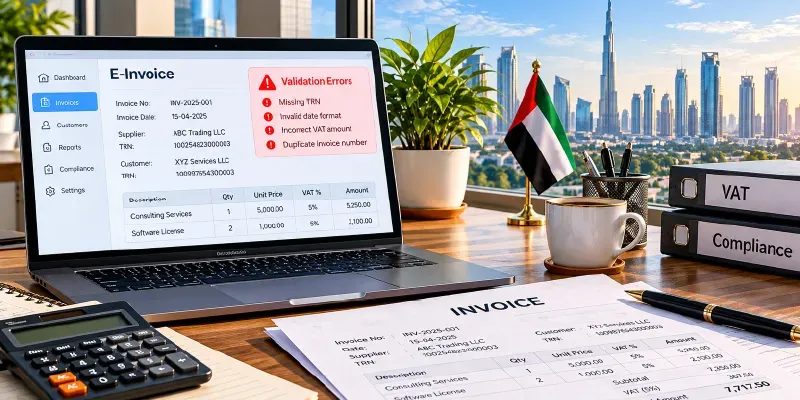
Table of Contents
UAE businesses are moving toward more structured and automated invoicing, making accurate invoice information more important than ever. E-Invoice Data Errors UAE businesses face may have impacts on validation, tax calculations, reconciliation, and electronic invoice exchange. Even a minor error in customer information, VAT, invoice sums or necessary fields can cause unnecessary processing problems. Applying trusted E-Invoicing Software in UAE can assist enterprises to arrange invoice data, apply equal rules, and decrease unwarranted manual labor.
Accurate and structured data creates a smoother invoicing workflow from invoice creation through accounting and electronic exchange. Businesses must also maintain reliable customer, supplier, product, tax and transaction records. Quickdice ae can help businesses wish to enhance structured invoicing procedures and minimize repetitive data entry. These ten mistakes commonly occur in the invoice data and the following are the ten ways that can be taken by the business to avoid invoice mistakes.
E-invoice data validation refers to the process of verifying invoice data by ensuring that it is accurate, complete, consistent, and formatted correctly and then exchanged electronically. It can look into the details of tax information, invoice number, invoice date, customer records, product information, product amount, VAT computation and required fields.
Validation is not the same as creating or issuing an invoice since it is a way of verifying information that it satisfies the specifications. Master data, tax values, calculations, identifiers, formatting and details of transactions should be checked by businesses to minimize rejected or inconsistent electronic invoices.
Incorrect legal names, old addresses, registration information or incomplete customer/supplier records may give rise to inconsistencies in the invoice. Prior to generating or exchanging invoices electronically, businesses ought to periodically evaluate master data, eliminate data that has become outdated, validate identifiers, and determine ownership so as to keep proper records.
The invoice validation and VAT reporting can be impacted by the absence or wrong tax registration information. E-Invoice Data Errors UAE businesses may have are possibly caused by old tax records, manual input or improper setups. Keeping tax records up to date and centralized records will assist businesses in keeping their records up to date.
Wrong rates of VAT, amounts of taxable, or calculation may cause discrepancy between the amounts on the invoice and accounting records. E-invoice Data errors UAE Companies may experience higher levels of errors in e-invoice data when they perform the calculations of the VAT manually. Validity checks, automatic computation and set tax rules can minimize calculation errors prior to the exchange of invoices.
The absence of invoice fields may result in inability to process them properly and cause discrepancies in financial records. Pre-transmission of incomplete customer information, supplier information, tax information, transaction information or other necessary fields need to be identified. Pre-validation assists companies to screen out information that is not provided and amend the invoices prior to electronic transfer.
Duplicate invoice numbers, wrong numbering sequence and inaccurate invoice date may undermine invoice controls and make invoice difficult to reconcile. A business must always have the same rules in numbering, avoid unnecessary manual corrections, be able to check the date during submission and count sequential records to detect odd gaps or duplicates in time.
Incorrect descriptions, quantities, unit prices and obsolete product and service records may have an impact on the accuracy of invoices. Companies ought to keep up to date product master data and verify the details of transactions prior to creating invoices. Invitable discrepancies in invoices can be minimized by standardized descriptions and approved prices, as well as controlled quantity entry.
Inaccurate invoice totals can be caused by subtotal errors, discount errors, VAT errors and rounding errors. Automated computations have the potential to mitigate arithmetic risks in the manual process and enhance consistency. E-Invoice Data Errors UAE businesses may be minimized in cases where the invoice systems are used to compute subtotals, discounts, taxes and final amounts based on set rules.
Duplicate invoices may occur due to duplication of manual entries, system lagging or ERP synchronization issues. The transaction can be recorded in a number of systems resulting in duplication of invoices. These problems can be avoided with the help of duplicate detection, unique invoice identifiers, synchronized records, and automated workflows.
Any discrepancy in the records between the ERP and electronic invoices may create a challenge in at least the reconciliation. The problems of master-data synchronization, integration, and API can transfer either outdated or incomplete information. Recording correct records can be assisted by automated synchronization, constant data mappings, tracking and regulated integration processes.
The structured electronic invoicing needs information to be formatted and in fields as required. Improper formats, lack of uniformity, missing fields or invalid identifiers can make it impossible to process. The data structure, required fields and formatting can be checked by automated validation prior to the exchange of the invoices electronically.
Manual data entry continues to be a fundamental cause of invoice errors particularly when employees enter identical customer, supplier, product, or tax data many times. The following can further predispose the invoice information to inaccuracy; outdated master data, spreadsheet based invoicing, inconsistencies of records, wrong VAT configuration and duplicate entry of data.
Mismatches can also arise in the exchange of partial or out-of-date records among systems during ERP integration. Companies that do not have automated validation can find errors afterwards. Recurring errors are more likely to be difficult to detect and rectify due to weak internal invoice controls, inconsistent workflows and lack of clarity in responsibility of maintaining master data.
Maintain customer, supplier, tax, product and service information on business systems. Delegate update tasks, periodically review records, delete old entries and ensure that key identifiers are accurate before permitting them to enter into invoice generations processes.
Have regular invoice fields, formats, naming conventions, numbers, and approvals. Standardization aids employees to key in information in a uniform way and facilitate easier validation of information in both accounting, ERP, tax and electronic invoicing systems.
Manual errors can be eliminated in automation of calculations that include VAT and discounts, subtotals, totals and rounding. Program approved tax and computation rules to create invoices in the same way without having to manually calculate them each time an employee needs to be paid.
Before electronic exchange use validation checks to check for missing values, incorrect values, invalid formats and calculation discrepancies. Pre-submission validation enables the employees to fix the invoice details at an early stage and minimizes unnecessary processing or rejection issues.
Integrating accounting or ERP with invoicing processes minimises data entry and synchronisation issues. The records of customer, supplier, transaction, tax and invoice records can be kept in sync in the linked business systems through automated transfer of information.
Reject, failed, duplicated or invalid invoices to determine repetitive issues. The analysis of error patterns assists businesses in understanding whether the problems are in master data, data input by the employees, the computations, integrations, configurations or internal control.
E-invoicing software may optimize the automation of data validation and organized invoice creation and minimize redundant manual entries. Automated VAT calculation, customer and supplier management, predefined fields and calculation rules assist business to make invoice records more consistent and have a fewer points of manual interventions.
ERP and accounting can be integrated to synchronize invoice information and limit duplicate entries. Automated duplicate detection, error detection, and invoice status monitoring can also assist businesses to detect problems early. Such abilities can facilitate a more regulated invoicing process and simplify the process of data review and correction prior to electronic exchange.
Accurate information is essential for maintaining a reliable electronic invoicing workflow. E-Invoice Data Errors UAE businesses are likely to suffer some data errors, which can be mitigated by means of clean master data, standardized invoice processes, proper tax settings, automatic calculations, and pre-submission validation. Prior to electronic exchange, checking the information related to customers, suppliers, products, transactions and invoices assists organizations to detect issues earlier and keep consistent financial records.
ERP integration may also minimize duplicate data entry and synchronization issues, with appropriate e-invoicing software able to automate validation, calculations, monitoring and error detection. A combination of powerful internal control and technology-oriented checks will allow businesses to build a more reliable invoicing process and be sure that an e-invoicing solution can be adjusted to its operations in the UAE.
Some of the common mistakes are wrong customer, VAT, invoice, calculation, product, totals, duplicates and formating.
Validation assists in detecting unfinished, inaccurate, inconsistent or improperly formatted data prior to electronic exchange of invoices.
Correct master data, standard processes, automation, validation verifications and integrated accounting systems can be used by businesses.
Yes, ERP integration will be able to minimize duplicate entries and enhance the synchronization between accounting and invoice records.
Duplicates can be detected through unique invoice numbering, automated duplicates check, integrated systems and monitoring transactions.
Businesses ought to check on required fields, customer information, tax data, calculation, invoice number, date and transaction data.